Conveyor-belt sushi is a tidy little game already. Plates go past, you grab the ones you want, and the colour of the plate tells you the price.
My brief for this one-shot was to re-imagine a sushi-belt game made in one shot at Ramen Club’s competition in London. The original is here. It was fun for a minute, but it had no goal and no way to get better at it.
Play Ramen Profitable. It needs a browser with WebGL2, and sound on. Play it before you read on, because the rest of this page gives the twist away.
The prompt
Here is my opening message, word for word, links and all.
https://ramen-oneshot-ad2de9b4d0c8.tiiny.site/ - Let’s reimagine this one. I think the game mechanics of this one are a little janky… like there’s no progression, or objective or challenge necessarily. We should apply proven addictive game mechanics to our re-imagining. One of the complaints I’ve recurringly had about our snake one was that it’s too hard - so we need to get the balance right between ‘too hard’ and ‘actually has a challenge’. Both the snake and potato games you made however had brilliant levels of humour in with classic jokes and references. The original we’re re-imagining here was at an event by https://ramenclub.com/ so we should bring references in to this, perhaps also to ‘indie hacking’ and ‘MRR’ etc. Perhaps jokes about being ramen profitable, ARRR metrics etc, and then consider who all the ‘foes’ are of indie hacking. All the while of course with sushi jokes too. We should do the same bait and switch as the other games though; where it starts off unassuming, 8-bit or simple then throws the user into the most incredible 3D worlds - though even this should perhaps be progressive rather than all in one go. So like every time we have whatever a level change, or they complete a sushi or something, it completely curveballs the user into a paradigm shift they didn’t even think was possible in the browser. Catchy music related to sushi, ramen and indie hacking. This is a start-up journey. Should be both desktop and mobile friendly in terms of visuals and controls; but don’t hold back on wild effects and wowing the user.
Then at least two more messages before it went live.
It’s a genre piece, not a copy. The name, the art, the music, the rules and the jokes are all original.
The idea
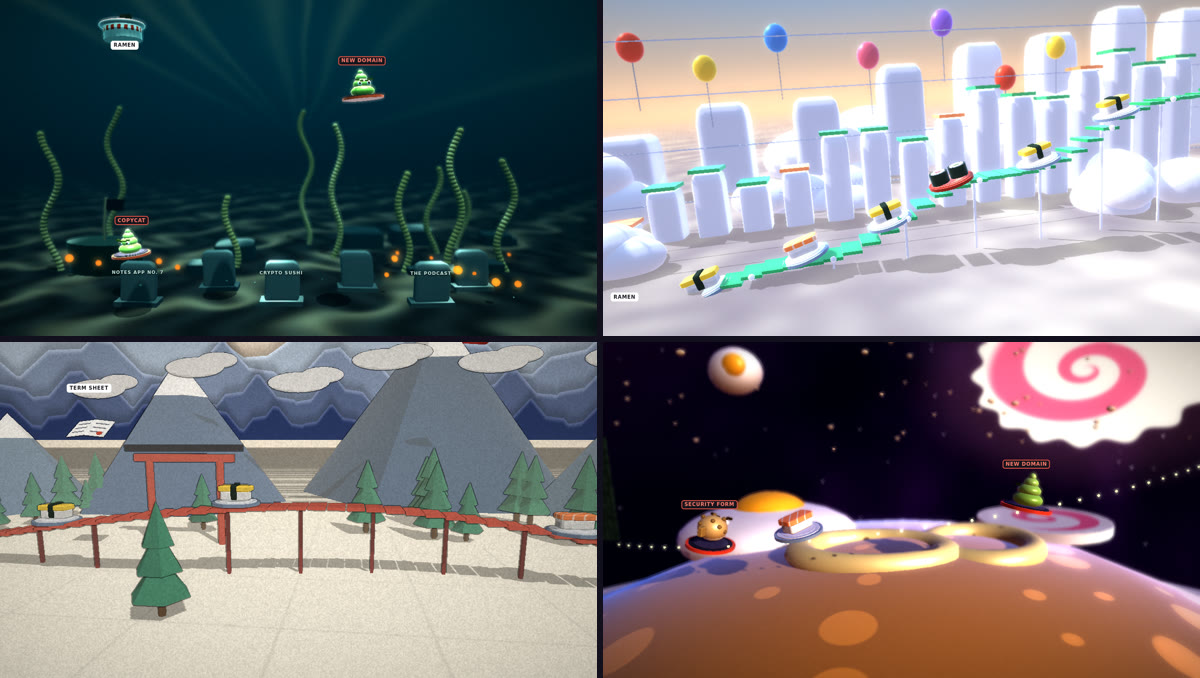
It opens as an honest 8-bit game: a sushi stall, a belt and a score. Grab eight plates and a box appears. “A man on the internet says: NICHE DOWN.” The game obeys. The camera dives into the bowl of ramen on the shelf, the pixels sharpen as it falls, and you surface in a sea of broth inside a bowl the size of a stadium.
That is the trick for the whole game. Each course starts with a piece of founder advice, and the game takes it literally. DO A DEEP DIVE drops you under the broth, to a seabed of dead side projects. UP AND TO THE RIGHT puts the belt on a rising chart above the clouds. RAISE A ROUND folds the world flat, because on paper you are now worth £4,000,000. SHOOT FOR THE MOON burns the paper away and leaves you in orbit round a ramen planet, under a galaxy shaped like a slice of fishcake. Then your mum says ZOOM OUT, LOVE.
The best bits
- The score is MRR and the health bar is runway. Plates buy runway back, and costs rise as you earn. Run out and you PIVOT: the world spins round and the course restarts. Nobody is sent back to the start.
- The foes of indie hacking arrive on black plates with their names on: SCOPE CREEP, SHINY OBJECT, QUICK CALL? and LIFETIME DEAL. Leave them alone.
- Ramen refills the runway. A gunkan roll ships everything on the belt, because gunkan means warship. Five pirate chests spell AARRR.
- Between courses you pick one of three upgrades, such as RAISE PRICES or LEARN TO SAY NO.
- Term sheets flutter past in the paper valley. Each one buys four months and costs a fifth of the company. The end screen prints what you kept.
- One tune runs through the game, re-arranged for each world: a chiptune at the stall, lift music for the investors. The sea gets a shanty.
- On a phone the camera swings round, so the belt runs towards your thumb.
How it was made
It’s one HTML file of about 130 KB. There are no libraries, no images and no audio files. The 3D is WebGL2 written by hand. Every object is built from six simple shapes, with shadows, depth of field and bloom on top. The 8-bit opening is the same 3D scene drawn flat, at low resolution, in 24 colours. That is why the dive into the bowl has no cut.
The difficulty was tuned before there was anything to look at. Bots of four skill levels played the rules hundreds of times, and the numbers moved until a weak player pivots about twice and a good one rarely does. Those bots now run as tests.
Claude built it in a single session on 14 November 2026, running Anthropic’s Fable 5.2 model, while I directed.
It’s the fourth of the Fable 5.2 One-shots: small browser pieces, each pushed as far as it will go in one session.